Lace Leaf Java Fern and Wood – 2.11 Gallons – Update

SAMSUNG CAMERA PICTURES


Last time I posted on this tank, it was to show off the hardscape and discuss my initial inspiration/motivation. Here was the initial hardscape:

Hardscape and First Plants 4

I’m never a fan of initial tank setup photos. They always look disappointing compared to what they become. Here is the same tank after a second round of planting:

2nd Planting

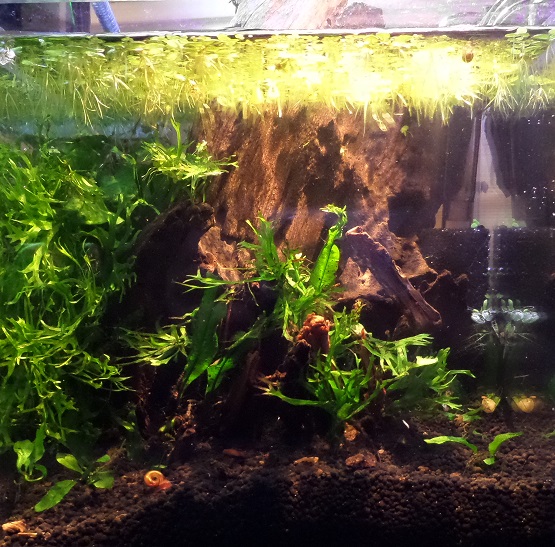
And, finally, a third round of adding more lace leaf java ferns:

I’m excited to see the java continue to grow and intertwine amid the wood. I also plan to add some shrimp to this tank! Not sure what kind yet. I want to be sure it has settled and would be a good home for them first.

Here’s a rundown on this this tank’s specs as of these final photos:

Tank – Aquatop 4.12 Gallon Cube, Low-Iron High-Clarity Glass, available here

Filter – Azoo Mignon Filter 60, rated for up to 3.5 gallons, available here

Substrate – Fluval Shrimp Stratum, available here

Lighting – Mr. Aqua Ultrathin Aquarium LED Clip Light, available here

  • I’m not sure how I feel about this light yet. It sure is bright, and based on the Mr. Aqua reputation I expect it is a good light. Yet the color is very blue, and it is a bit too large for this tank. I’d probably like and appreciate it more on a different tank. I also tend to like warmer light. For some of the shots above, I moved my little Ikea desk light over to warm up the shots.

Heater – Aquatop Nano Aquarium Heater with Thermostat, NH-15W, available here

Plants – The only plants in here are lace leaf java fern and a floating moss ball I put behind the wood centerpiece. I added it since previously that moss had been floating in a cycled tank and growing well. It only floats because I placed a single cut-out bubble from a sheet of large bubble wrap within the moss using some string. There is also some regular java fern in there, but mostly to keep the tank looking more full for now. There are also some floating plants in there – frogbit an some other random ones from other tanks. They helped it cycle and keep the light from being too bright for the java fern below, which is a low-light plant for the most part.

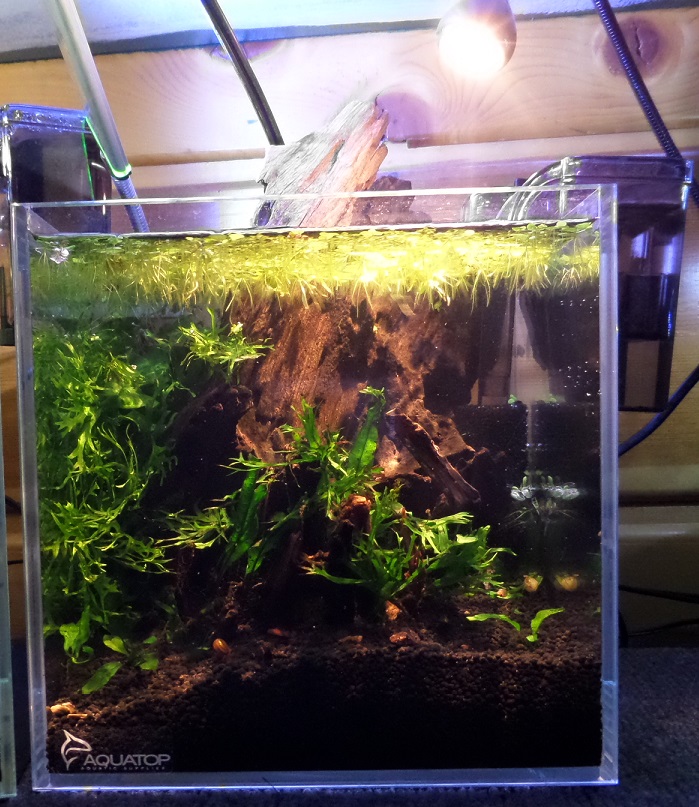
Here is a shot of the tank that shows off how the equipment is setup. The filter is on the right side. The heater is behind the wood, such that the filter outflow and intake still interact with in front of and behind the wood.
SAMSUNG CAMERA PICTURES

This shot also really helps show off how cold looking the Mr. Aqua light is compared to the Ikea desk lamp. I’m not saying anything about the quality of the lights or ability to grow plants, just the aesthetics they create. I also really love how the main piece of wood juts out above the tank rim. This can be a very effect tool for making smaller tanks look even larger. Getting a decent light balance to really show off this aspect in standard tank shots is hard for me right now, but it would be worth it in the future.

Lastly, here is the tank on my aquarium shelf, next to my 4.12 gallon rimless cube and the 3 gallon bowl upgrade that my original 1 gallon Walstad received. I’ll probably do a post on the bowl Walstad tank once it has settled and I’m a bit happier with it.

SAMSUNG CAMERA PICTURES

Lace Java Fern and Wood – 2.11 gallons – Initial Setup

I really love Lace Leaf Java Fern (Microsorium pteropus v. Windelov). It has such a beautiful, rich green color with intricate and delicate features. It is savage, raw, and angular, yet something about it is as soft and provocative as the lace for which it was given its common name. Here are some pics of my lace leaf java fern.

It was this plant that inspired my idea for this tank. I decided to go with all wood and lace java fern, though a few regular java ferns are in there too, and there’s some moss in the back to keep everything in balance. The idea of having wood be as angular and thrusting into the air above as the tips of the lace leaf really resonated with me. I chose a dark, thick, angled, throne-like shaped piece of Malaysian bogwood for the main wood feature. It’s beautiful grain swirled gently around the sharp bends, really capturing the attributes I wanted the tank to display. I didn’t have many small pieces, and I really wanted to have many jutting, striving branches of sorts around the main piece, hiding its base. For this I used small sections of broken off bogwood and some lighter pieces of aquarium safe wood I had lying around from previous purchases. This added nice depth and variation to the wood itself – again making the wooden sections more intricate and complex. All of these smaller pieces were angled upward from the substrate, all pointing to the same far away spot, creating a perspective point as if the tank were much larger than its actual size.

I couldn’t find a ton of lace java fern more than the few pieces I had at the time. I added what I did have, a large moss ball from another tank, and began preparing it to house shrimp in the future. Here was the tank on the first day:

I’ll be doing an updated post with how this tank came out  and all of the equipment running it soon!

Farewell to My 10 Gallon

My basic ten gallon tank had become the repository for fish that I couldn’t bring myself to bring back to the store. It had been my first tank, originally overstocked with platies and a pleco on the advice of a fish store salesperson. This is the tank I learned my first, brutal lessons on fish tank cycling, handling livebearers who just keep on making fry, and keeping proper ratios of male to female fish who get aggressive when wanting to mate.

Anyhow, this ten gallon recently saw the passing of the bright yellow betta who had been living there. He jumped out of the tank in the middle of the night, only to be found crunchy on the floor the next morning. This has been the only way I’ve ever lost a betta – they manage to find any small holes in a tank’s cover if they really feel like jumping. Here’s the tank and the betta:

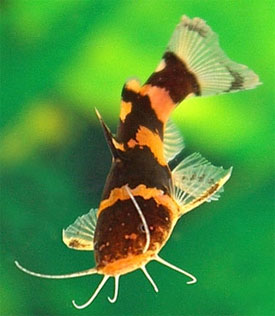
What remains are the eight black neon tetras and three microglanis iheringi, aka South American Bumblebee catfish. I’ve never been a huge fan of smaller schooling tetras beyond using them for aesthetics, but I absolutely love my little catfish! There isn’t a whole lot of information on these little micro cats, which is a large part of what has inspired me to begin planning my first biotope tank around their natural habitat. I tried getting some pictures of them this morning, but these little guys are ridiculously fast. I didn’t think to grab the camera until after their initial feeding, and then not even some defrosted blood worms could tempt them from their hiding spots:

SAMSUNG CAMERA PICTURES

So instead, here is a photo from this site to give you an idea of what these guys actually look like:

Microglanis_iheringi2

I love watching them come out to chomp down on food, frantically swimming around through all of the nooks and crannies in the wood and through all of the bottom plants to suck in a mouthful of food. Yet the most comprehensive source I can find on this species is from fishbase.com, located here. They’re originally from the “Turmero River Basin.” Yet every website that contains similar phrases is either about this exact species or about the pollution of that waterway. The Turmero river flows into Lake Valencia, located in north-eastern Venezuela, South America. I plan on making this location my first biotope.

If you have any information on Venezuelen fish species that might be available and be okay in a smaller tank (I’m thinking a 20 gallon long – with high flow to make a river type system), let me know! For now, there seem to be many options for guppies, tetras, or killies, and it would be nice to have the bumblebee cats to keep the fry levels in check!

There are also many other options I’ve been considering with the new tank spot I could have now, maybe a Scarlet badis (dario dario) tank? Peacock Gudgeons? American native darters? Killifish breeding? White Clouds? Furcata Rainbows? Gurtrudae Rainbows? Can’t wait to find out.