11.33 Gallon – “Death Mountain” Update

11 6

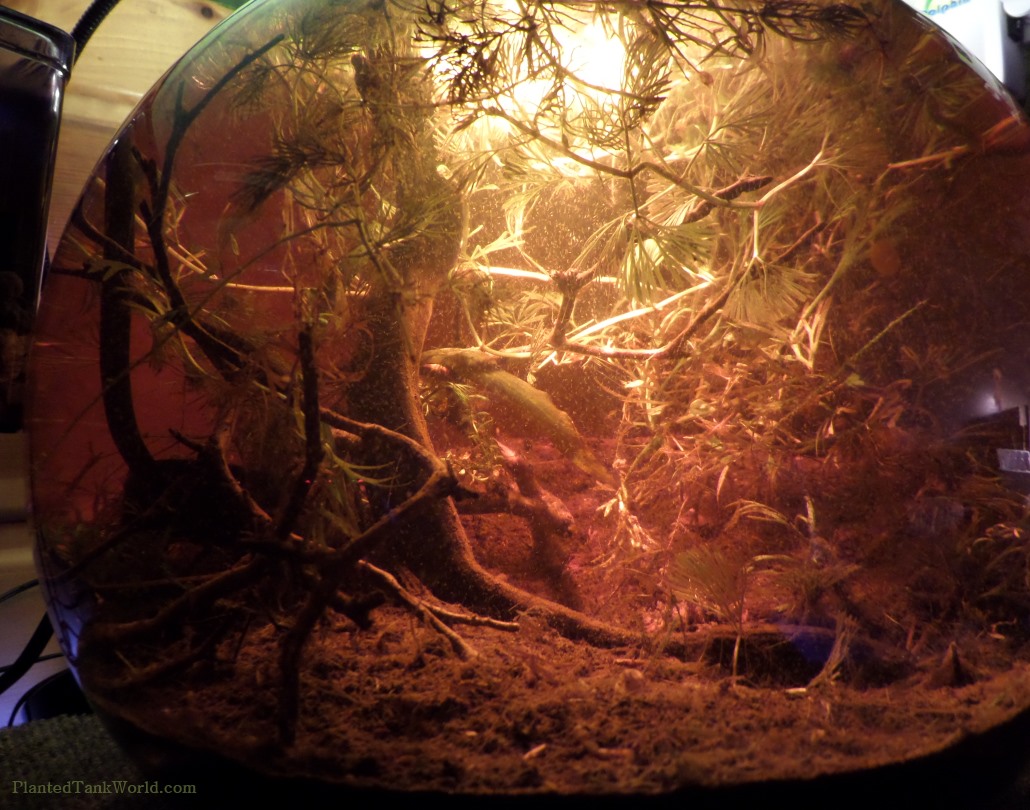
Here’s my “Death Mountain” tank, though the way I’ve been trimming the vallisneria spiralis (the tall green plant in the back left corner) and cutting all other plants low has made the similarity to the video game mountain less obvious.

Plants are starting to grow in well, and my red cherry shrimp began breeding almost immediately after being added. I’ve still got the Boraras brigittae swimming around in the back of many of the full tank shots. They were doing quite well, being very friendly and adventurous, until a recent water change that disrupted the substrate. I’m planning on setting up a more stable habitat for them, with lower lighting and more leafy plants to hide in, quite soon. I’m also tempted to add in a gas CO2 system to improve growth, because my impatience is starting to get the best of me!

These are the newest inhabitants of this tank. I ordered 30 red cherry shrimp. They were rather cheap, as many were culls from a shrimp breeder. Included with the shrimp were also three fish I hadn’t expected. Two red wag platies and a female guppy, all still quite small and young, were thus added to the tank with the shrimp.

I am really enjoying watching the shrimp go about their daily activities! Their limbs are a blur of motion, constantly picking up little tidbits from around them. The males are rather pale and small compared to the bright red females. They group together in a huge colony when feasting on added food.

I’ll update again once the tank has progressed further!
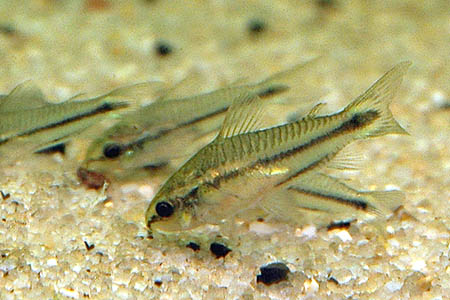
Tiny Corydora Species

Basic Requirements of Tiny Corydora

  • Must be kept in groups – Keep at least six, ideally nine or far more.
  • Need soft substrate – Their barbels (small whisker-like bits by their mouths) get worn down on large rocks. Stick to fine gravel or sand.
  • Need hiding spots – These fish all come from waters with lots of tree roots, rocks, etc. This needs to be recreated for them to fair well in a tank. ->Think Amazon River Biotope
  • Need stable water– Only add these corydora to established tanks. They will not tolerate salt, medications, or chemical spikes well.
  • Prefer subdued lighting – Having floating plants or many obstructions of the light will reduce their stress and encourage them to come out more frequently.
  • Need sinking food source – Switching their diet between bottomfeeder/agae pellets with the occasional addition of frozen brine shrimp, daphnia, or minced blood worms should keep them happy enough. Avoid letting uneaten food accumulate.
  • Need peaceful, small tankmates – Larger fish will try to eat these little Corydora. Keep them alone or with other similarly sized species.

Signs of Stress

All these species of cory will show signs of stress when they need your help to alter their environment, food source, etc. If you see any, and especially if you see multiple, of your corydora displaying signs of stress, test your water to see if you can identify a cause (such as a mild ammonia spike or temperature out of range) and perform a partial water change.

  • breathing heavily/rapidly – watch their gills on the sides of their face
  • inactivity/just sitting around – healthy corydora are quite active!
  • rolling or flicking their bodies
  • staying on their sides

Pygmy Corydora, (C. pygmaeus)

corydoras_pygmaeus_2

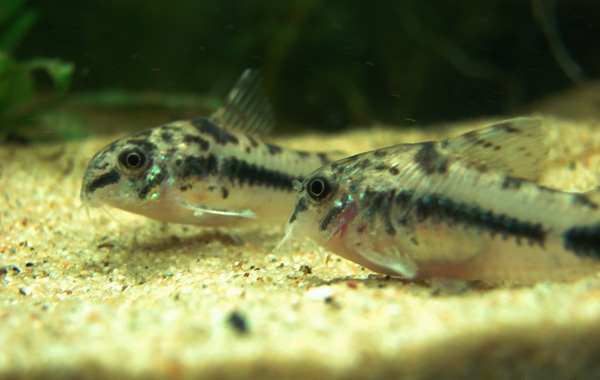
The Pygmy Corydora: reaches ~1.2″, dark stripe along either side, occasionally swims mid-level in the tank but mostly are bottom-dwelling

Water: Soft to medium-hard, acidic to slightly basic (6.5-7.5) , 71 – 79 degrees Fahrenheit

Here is a phenomenal video of a huge group of Pygmy Corydora: https://www.youtube.com/watch?v=0Bizjkn8bGw

Dwarf Corydora, (C. hastatus)

Other names for it include Tail Spot Pygmy Cory and Panzerwels Corydora/Catfish

Dwarf Corydora: distinguished by the diamond shaped marking neartheir tail with otherwise few markings, females reach ~1.3″ while males stay a bit smaller, will spend a great deal of time mid-level an swimming about

Water: 72 – 79 degrees Fahrenheit, pH of 6.0 to 7.2,

Salt and Pepper Corydora, (C. habrosus)

2corydoras-habrosus

Salt and Pepper Corydora: reach 1.4″ max, enjoy limited water movement, extremely active and outgoing compared to the other tiny corydora listed

Water: Temperature 72 – 79 degrees Fahrenheit, pH 6.2 to 7.2, Hardness 2 – 12 degrees

3.8 Gallon Walstad Bowl

w 32

I wanted to try my hand at a completely low-maintenance tank, and this was the result. It’s gone through many phases, but it currently sits as a dark, tannin rich environment with crypts, cabomba, and floating plants. It once had far more plants, but over time I began transplanting these into other tanks that needed more cover. It also once had a far brighter light, but that, too, was given to another, more demanding tank.

w 23

During a planaria culture – easy, free, live fish food!

One huge benefit of having a tank without any inhabitants beyond hardy plants is that I can play with the tank as I wish. One of my favorite ways to use this tank is to intentionally grow planaria for food. Many smaller fish and picky eaters will eat planaria – but having planaria in your tank is usually a sign of excess, uneaten food and poor water quality. Thus, I can add food to this fishless bowl, let the planaria grow, and siphon them out to use as food.

w 13

This tank is far different from most of my tanks, as it has no filter, no heater, and no living creatures I intentionally added. Yet it is also one of my most unique environments. I really love the dark, tannin rich water, creating beautiful silhouettes out of the cabomba and wood in the tank.

w 10

Right now I only ever really bother to top off this tank with conditioned water. Perhaps I’ll go ahead and do an actual water change on it in the future to lighten the water color or prepare it for more plants or even some snails or inverts. But for now, I’m enjoying the evolution of this dark and still world amid the other brightly lit tanks with constant water current.